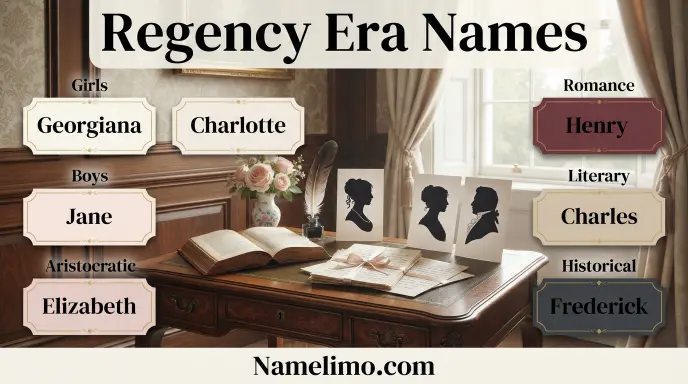
Regency era names have a refined, literary feel shaped by early 19th century British society.
Names such as George, Henry, Charles, Edward, Jane, Eliza, Charlotte, Anne, and Emma fit the period well.
They can inspire baby names, historical characters, pen names, and period style fiction.
What Makes a Name Feel Regency Era?
The British Regency is usually associated with the period from 1811 to 1820, when George, Prince of Wales served as Prince Regent during the illness of his father, George III.
The wider cultural period is often treated more broadly when discussing Regency fashion, literature, and social life.
Names from this setting often came from established English naming traditions. Biblical names, royal names, family names, and names inherited from earlier generations were all common sources.
For a historically convincing character, the name should fit the person’s family, social setting, and approximate date rather than simply sounding old fashioned.
Elegant Names for Girls
Women’s names from the period often have a graceful, formal quality. Many also became strongly associated with Georgian and Regency literature.
Classic Choices
- Jane
- Anne
- Emma
- Eliza
- Elizabeth
- Charlotte
- Caroline
- Catherine
- Mary
- Amelia
- Harriet
- Louisa
- Sophia
- Frances
- Georgiana
- Eleanor
- Lydia
- Fanny
- Margaret
- Isabella
Names such as Jane, Elizabeth, Anne, and Mary have much older histories, but their continued use makes them suitable for Regency settings.
More Refined Choices
- Arabella
- Augusta
- Beatrice
- Cecilia
- Clarissa
- Constance
- Cordelia
- Henrietta
- Marianne
- Penelope
- Rosamund
- Theodora
- Letitia
- Matilda
- Octavia
These choices can work particularly well for aristocratic or upper class fictional characters.
Strong Names for Men
Men’s names from this period often came from royal families, saints, biblical traditions, and inherited family names.
Familiar Choices
- George
- Henry
- Charles
- Edward
- William
- James
- John
- Thomas
- Robert
- Richard
- Arthur
- Frederick
- Francis
- Joseph
- Samuel
- Edmund
- Alfred
- Philip
- Frederick
- Benjamin
Several of these names remained popular for generations, making them useful for characters from different social backgrounds.
Distinguished Choices
- Augustus
- Benedict
- Edmund
- Leopold
- Percival
- Reginald
- Rupert
- Sebastian
- Theodore
- Archibald
- Bartholomew
- Maximilian
- Montgomery
- Nathaniel
- Laurence
Longer forms can give an aristocratic character a formal introduction while allowing a shorter nickname in everyday dialogue.
Names Inspired by Regency Society
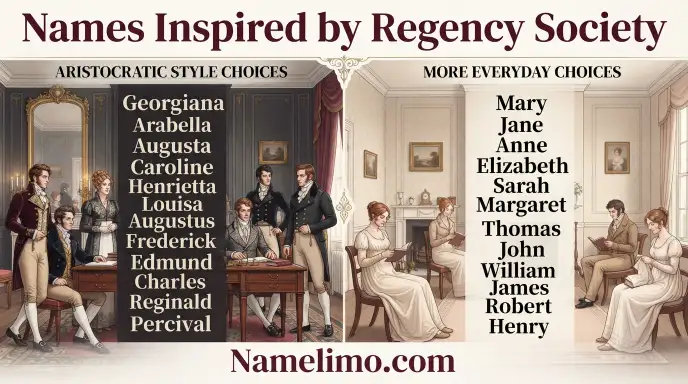
Social class influenced naming patterns, but names were not exclusive to one class. A historical character’s full identity also depended on family background, occupation, religion, location, and inheritance.
Aristocratic Style Choices
For an upper class fictional family, names such as these can create the right atmosphere:
- Georgiana
- Arabella
- Augusta
- Caroline
- Henrietta
- Louisa
- Augustus
- Frederick
- Edmund
- Charles
- Reginald
- Percival
A character named Georgiana or Frederick can immediately feel at home in a formal historical setting, especially when paired with an appropriate surname.
More Everyday Choices
- Mary
- Jane
- Anne
- Elizabeth
- Sarah
- Margaret
- Thomas
- John
- William
- James
- Robert
- Henry
These names are useful when you want a character to feel historically grounded rather than unusually ornate.
Names Found in Regency Literature
Literature from and around the Regency period provides a rich source of inspiration.
Jane Austen’s novels are especially useful because they feature names such as:
- Elizabeth Bennet
- Jane Bennet
- Emma Woodhouse
- Anne Elliot
- Elinor Dashwood
- Marianne Dashwood
- Catherine Morland
- Fanny Price
- Harriet Smith
- Caroline Bingley
- George Knightley
- Edward Ferrars
- Henry Tilney
- Edmund Bertram
- Frederick Wentworth
These names can help capture the literary atmosphere of the period without relying on invented historical patterns.
Pretty Choices With a Romantic Feel
Some names naturally suit the romantic atmosphere often associated with Regency fiction.
Feminine Options
- Amelia
- Arabella
- Caroline
- Charlotte
- Eliza
- Georgiana
- Harriet
- Isabella
- Louisa
- Marianne
- Sophia
Masculine Options
- Alexander
- Charles
- Edward
- Frederick
- Henry
- James
- Laurence
- Theodore
- William
- Edmund
For fiction, pairing a familiar first name with a suitable surname can create a stronger period impression than choosing an extremely unusual first name.
Short Names and Nicknames
Formal names were often shortened in everyday conversation. Nicknames can also help show relationships between characters.
Feminine Short Forms
- Anne
- Beth
- Fanny
- Jane
- Kitty
- Lizzie
- Lucy
- Polly
- Sally
Masculine Short Forms
- Bert
- Dick
- Fred
- Harry
- Jack
- Ned
- Tom
- Will
For example, Edward could become Ned, while Frederick could become Fred. The exact nickname used can help communicate familiarity or affection between characters.
Surnames for Historical Characters
A convincing Regency character needs more than a period appropriate first name. The surname should also fit the story’s social and geographic setting.
Fictional Surname Ideas
- Ashford
- Bellamy
- Blackwood
- Cavendish
- Fairchild
- Harrington
- Hawthorne
- Kensington
- Langley
- Montague
- Pembroke
- Ravenscroft
- Sinclair
- Thornton
- Wentworth
Some surnames above are established family names, while others are presented here as creative options for fictional characters. A surname alone does not prove aristocratic status.
Full Name Combinations
- Georgiana Ashford
- Charlotte Pembroke
- Eliza Harrington
- Marianne Bellamy
- Henry Ashford
- Edward Thornton
- Frederick Langley
- Charles Pembroke
- Edmund Fairchild
- William Harrington
Names for Regency Romance Characters
Historical romance often benefits from names that are easy to remember while still fitting the period.
Heroines
- Amelia Hart
- Charlotte Bellamy
- Eliza Ashford
- Georgiana Vale
- Harriet Langley
- Marianne Fairchild
- Sophia Thornton
Heroes
- Edward Hart
- Henry Bellamy
- Frederick Ashford
- Charles Vale
- Edmund Langley
- William Thornton
- Alexander Fairchild
These are creative combinations rather than claims about historical individuals.
Names for Aristocratic Families
If you are creating a fictional noble family, repeating traditional family names across generations can make the family feel more believable.
Family Name Set
Daughters:
- Georgiana
- Caroline
- Augusta
- Henrietta
- Charlotte
Sons:
- Frederick
- Charles
- Edmund
- Henry
- William
You can also give siblings formal names with different everyday forms. For example, Frederick, Charles, Georgiana, and Henrietta create a consistent upper class fictional family style.
Regency Names With Biblical Roots
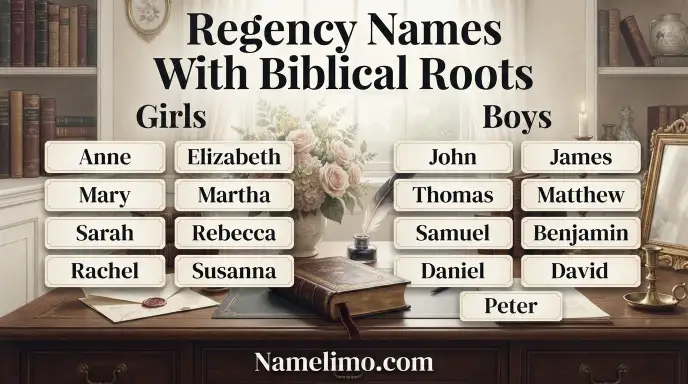
Christian naming traditions were important in Britain long before the Regency period, so many familiar biblical names fit naturally into historical settings.
Girls
- Anne
- Elizabeth
- Mary
- Martha
- Sarah
- Rebecca
- Rachel
- Susanna
Boys
- John
- James
- Thomas
- Matthew
- Samuel
- Joseph
- Benjamin
- Daniel
- David
- Peter
These names should not be treated as uniquely Regency choices. Their value comes from their long standing use in English speaking communities.
Less Common Historical Choices
If you want something less familiar than Jane, Elizabeth, Henry, or William, consider names with a more formal historical sound.
Girls
- Adelina
- Augusta
- Clarissa
- Euphemia
- Henrietta
- Honoria
- Lavinia
- Letitia
- Millicent
- Theodosia
Boys
- Ambrose
- Archibald
- Bartholomew
- Clement
- Godfrey
- Leopold
- Percival
- Reginald
- Rupert
- Wilfred
Some of these names had long histories before the Regency and are included for their historical character rather than as uniquely period created names.
How to Create a Convincing Period Name
Choosing a historical name is easier when you consider the whole character.
Start With the Family
Ask what kind of family the character comes from. A wealthy aristocratic household may use more formal inherited names, while a working or middle class character might have a simpler naming style.
Consider the Date
The Regency period was relatively short, but naming habits did not suddenly change in 1811. Names carried forward from previous generations.
Match the Setting
British names may feel different from names used in Ireland, Scotland, Wales, continental Europe, or Britain’s overseas communities. Location matters.
Give the Character a Natural Nickname
A formal name can become more believable when characters use a familiar short form in private conversation.
Regency Era Naming Tips for Writers
A good historical name should support the character instead of distracting from the story.
- Check the historical period before using a very modern name.
- Consider the character’s social background.
- Match the name to the family’s cultural setting.
- Use established names when historical accuracy matters.
- Research unusual names before presenting them as period specific.
- Give aristocratic characters suitable surnames without assuming every old surname indicates nobility.
- Use nicknames to show relationships between characters.
- Avoid giving every character an elaborate name, since ordinary names were also common.
Frequently Asked Questions
1. What names were popular during the Regency era?
Names such as George, William, Henry, Charles, John, Edward, Elizabeth, Mary, Jane, Anne, Caroline, and Charlotte fit the British naming traditions of the period. Exact popularity rankings require historical records from a specific place and year.
2. What is a good Regency name for a girl?
Georgiana, Charlotte, Caroline, Elizabeth, Jane, Amelia, and Harriet are strong choices for a British historical setting. The best option depends on the character’s family, location, and social background.
3. What is a good Regency name for a boy?
Henry, Edward, Charles, George, Frederick, William, Edmund, and James work well for male characters set in the period.
4. What names sound aristocratic?
Names such as Georgiana, Augusta, Arabella, Henrietta, Augustus, Frederick, Percival, and Reginald can create a formal aristocratic impression in fiction. A name alone does not establish historical rank.
5. What are some Regency romance names?
For heroines, consider Amelia, Charlotte, Georgiana, Eliza, Marianne, or Sophia. For heroes, Edward, Henry, Frederick, Charles, Edmund, or William can suit a romantic historical setting.
6. Are Regency names the same as Victorian names?
There is significant overlap because naming traditions continued across periods. Regency Britain is generally associated with 1811 to 1820, while the Victorian era began with Queen Victoria’s accession in 1837.
Names should therefore be matched to the specific historical setting rather than treated as interchangeable labels.
Final Thoughts
The best Regency inspired names combine historical plausibility with the personality of the character or child.
Familiar choices such as Jane, Elizabeth, Henry, Edward, and Charles provide a grounded period feel, while names such as Georgiana, Arabella, Augustus, and Percival create a more formal atmosphere.
For fiction, consider the complete name, family background, location, and nickname together.
Explore More Beautiful Names
- Spanish Names to Call Your Girlfriend: Romantic & Sweet Ideas
- Cool Latin Names: 200+ Stylish, Unique & Powerful Ideas
- Cool Japanese Boy Names: 150+ Modern, Strong & Unique Ideas

I’m Grace Anderson, a name researcher and the writer behind NameLimo. I love discovering unique and meaningful names for babies, pets, characters, and businesses, helping readers find the perfect name with confidence.