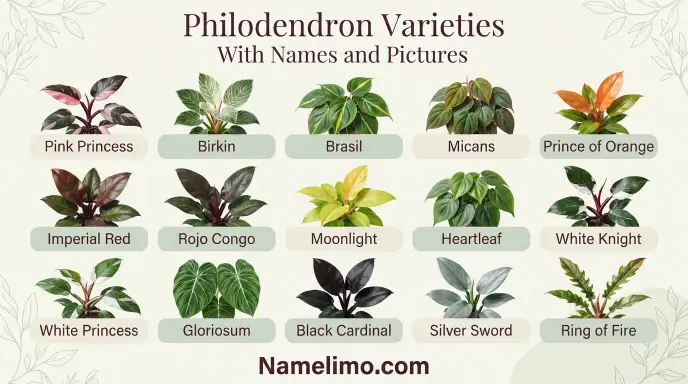
Philodendrons are popular tropical houseplants known for their attractive foliage and wide range of leaf shapes, colors, and growth habits.
Some varieties have heart shaped leaves, while others feature deeply divided, velvety, silver, or brightly variegated foliage.
This guide covers philodendron varieties with names and pictures to help you recognize popular types and understand what makes each one different.
Popular Philodendron Varieties
Philodendrons come in many forms, but some varieties are especially recognizable among houseplant growers.
Philodendron Pink Princess
Philodendron Pink Princess is famous for its dark green leaves with irregular pink variegation. The amount and pattern of pink can differ from leaf to leaf, giving each plant a distinctive appearance.
It has a climbing growth habit and can develop larger foliage when given suitable support.
Key features: Dark green leaves, pink variegation, climbing growth, and pointed foliage.
Philodendron Birkin
Philodendron Birkin is recognized by its dark green leaves marked with fine white or cream colored lines. The stripes create a pinstripe effect that makes this cultivar easy to distinguish from many other philodendrons.
The plant generally grows in an upright, self heading form.
Key features: White pinstripes, dark green foliage, upright growth, and compact form.
Philodendron Brasil
Philodendron Brasil is a colorful form of the heartleaf philodendron. Its heart shaped leaves typically feature a bright yellow green stripe running through the center of darker green foliage.
Its trailing stems make it suitable for hanging baskets, shelves, and climbing supports.
Key features: Heart shaped leaves, green and yellow green coloring, trailing stems, and climbing habit.
Philodendron Micans
Philodendron Micans is loved for its soft, velvety leaves. Depending on the lighting and stage of growth, the foliage can show deep green, bronze, or reddish tones.
It is a trailing and climbing type that can look especially attractive when allowed to grow downward from a shelf.
Key features: Velvety texture, heart shaped leaves, dark green and bronze tones, and trailing growth.
Philodendrons With Colorful Leaves
Some varieties stand out because their foliage changes color as new leaves emerge.
Philodendron Prince of Orange
Prince of Orange is known for its bright orange new leaves. As the foliage matures, the color gradually shifts through yellow green shades before becoming greener.
This variety grows upright and forms a compact plant.
Key features: Orange new foliage, changing leaf colors, upright growth, and compact shape.
Philodendron Imperial Red
Imperial Red produces reddish new foliage that becomes darker as the leaves mature. Its broad leaves and upright growth give it a bold tropical appearance.
It works well as a floor plant or as a focal point in a larger indoor plant collection.
Key features: Red new growth, broad leaves, upright habit, and dark mature foliage.
Philodendron Rojo Congo
Rojo Congo is an upright cultivar with large leaves. New foliage can emerge in red or burgundy shades before developing deeper green tones.
Its broad leaves give the plant a substantial appearance even when grown indoors.
Key features: Large leaves, reddish new growth, upright habit, and dark green mature foliage.
Philodendron Moonlight
Moonlight has elongated foliage and bright new growth. Young leaves can appear lime green or yellow green before becoming deeper in color.
It grows upright rather than producing long trailing vines.
Key features: Lime green new leaves, elongated foliage, upright growth, and compact form.
Philodendrons With Unusual Leaf Shapes
Leaf shape is one of the easiest ways to distinguish different philodendron types.
Philodendron Xanadu
Philodendron Xanadu has deeply divided leaves that give it a lush tropical appearance. It forms a bushy, upright plant rather than a long trailing vine.
The name is still widely used in horticulture, although the plant is now classified as Thaumatophyllum xanadu.
Key features: Deeply divided leaves, upright growth, bushy form, and tropical foliage.
Philodendron Selloum
Philodendron Selloum is another commonly used name associated with a large, deeply lobed foliage plant. Modern botanical classification places it in the genus Thaumatophyllum.
Its mature foliage can become very large, creating a dramatic tropical display.
Key features: Large leaves, deep lobes, upright growth, and broad tropical form.
Heart Shaped Philodendron Varieties
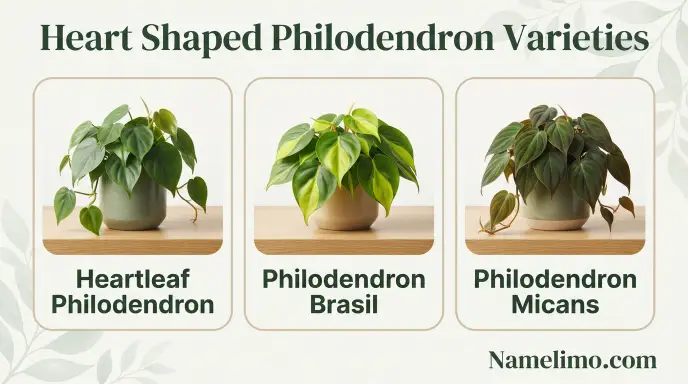
Heart shaped leaves are strongly associated with several popular philodendrons.
Heartleaf Philodendron
The heartleaf philodendron is a classic trailing houseplant with simple green, heart shaped leaves. Its flexible stems can trail from shelves or climb a support.
It is one of the most recognizable philodendron types for indoor growing.
Key features: Green heart shaped leaves, trailing stems, climbing ability, and simple foliage.
Philodendron Brasil
Philodendron Brasil also has heart shaped leaves, but its central yellow green variegation creates a much more colorful appearance than the standard heartleaf type.
Key features: Heart shaped foliage, bright central variegation, and trailing growth.
Philodendron Micans
Micans has the same general heart shaped foliage but adds a distinctive velvety texture and darker coloring.
Key features: Heart shaped leaves, velvet like surface, bronze green tones, and trailing stems.
Variegated Philodendron Varieties
Variegated philodendrons are especially popular because their leaves can display contrasting colors.
Philodendron White Knight
White Knight has dark green leaves with irregular areas of white variegation. Its climbing growth habit and contrasting foliage make it a striking collector plant.
Key features: White and green variegation, dark foliage, climbing growth, and irregular patterns.
Philodendron White Princess
White Princess is another highly recognizable variegated philodendron. Its green leaves can contain white sections, and some foliage may also show pinkish tones.
It is often compared with White Knight because both have white variegation.
Key features: Green leaves, white variegation, occasional pink tones, and climbing growth.
Philodendron Ring of Fire
Ring of Fire is known for its narrow, serrated leaf edges and changing foliage colors. New leaves may show shades of yellow, orange, or red before becoming greener.
Key features: Serrated edges, changing colors, multicolored foliage, and upright growth.
Philodendrons With Large Leaves
Large leaf varieties can create a strong tropical effect indoors.
Philodendron Gloriosum
Philodendron gloriosum is admired for its broad, heart shaped leaves and prominent pale veins. Unlike many climbing philodendrons, it has a creeping growth habit.
Its large foliage makes it particularly attractive to collectors who enjoy dramatic tropical plants.
Key features: Large heart shaped leaves, strong veins, crawling growth, and broad foliage.
Philodendron Verrucosum
Philodendron verrucosum is known for large, velvety leaves with prominent veins. The foliage often has a rich green color and a textured surface.
It is a climbing species that can become especially impressive when grown with suitable support.
Key features: Velvety leaves, prominent veins, large foliage, and climbing growth.
Dark Philodendron Varieties
Dark foliage can give an indoor plant collection a dramatic appearance.
Philodendron Black Cardinal
Black Cardinal is known for its very dark foliage. New leaves can emerge in burgundy or deep reddish shades before becoming darker as they mature.
The plant grows upright and forms a relatively compact shape.
Key features: Dark leaves, burgundy new growth, upright habit, and compact form.
Philodendron Black Congo
Black Congo is another dark leaved cultivar with large foliage and an upright growth habit. Its new leaves can appear reddish before developing deeper green tones.
Key features: Dark foliage, broad leaves, upright growth, and reddish new leaves.
Philodendrons With Silver Foliage
Some species are especially noticeable because of their unusual metallic looking leaves.

Philodendron Silver Sword
Philodendron hastatum, commonly known as Silver Sword, has elongated leaves with a distinctive silvery blue appearance. Its foliage becomes more arrow shaped as the plant matures.
It is a climbing type and can develop an attractive vertical form when given support.
Key features: Silver blue leaves, arrow shaped foliage, climbing habit, and metallic appearance.
Philodendron Florida Ghost
Florida Ghost is famous for its pale new foliage. Fresh leaves can emerge very light before gradually becoming greener as they mature.
Its unusual leaf shape and changing color make it a popular choice for plant collectors.
Key features: Pale new leaves, changing foliage color, unusual leaf shape, and climbing growth.
Philodendron Varieties at a Glance
| Variety | Distinctive Feature | Growth Habit |
| Pink Princess | Pink variegation | Climbing |
| Birkin | White pinstripes | Upright |
| Brasil | Yellow green central variegation | Climbing |
| Micans | Velvety leaves | Climbing |
| Prince of Orange | Orange new foliage | Upright |
| Imperial Red | Red new foliage | Upright |
| Rojo Congo | Burgundy new growth | Upright |
| Moonlight | Lime green new leaves | Upright |
| Xanadu | Deeply divided leaves | Upright |
| Heartleaf | Green heart shaped leaves | Climbing |
| White Knight | White variegation | Climbing |
| White Princess | White variegation | Climbing |
| Ring of Fire | Serrated multicolor foliage | Upright |
| Gloriosum | Large veined leaves | Crawling |
| Black Cardinal | Very dark foliage | Upright |
| Silver Sword | Silver blue leaves | Climbing |
| Florida Ghost | Pale new leaves | Climbing |
How to Identify Different Philodendrons
A single feature is not always enough to identify a plant. Compare several characteristics together.
Look at Leaf Shape
Heart shaped, elongated, lobed, and serrated leaves can help narrow down the variety.
Check the Leaf Texture
Some philodendrons have smooth foliage, while Micans and several other species have a noticeably velvety surface.
Observe New Growth
New leaves can provide useful clues. Prince of Orange, Imperial Red, and Florida Ghost are particularly notable for their distinctive new foliage.
Examine Variegation
Look at both the color and pattern of variegation. Birkin has fine lines, Brasil often has a central stripe, while Pink Princess develops irregular pink areas.
Consider Growth Habit
Determine if the plant climbs, trails, crawls, or grows upright. This can help separate varieties with similar looking leaves.
Climbing and Upright Philodendrons
Growth habit is an important difference between philodendron types.
Climbing Types
Common climbing examples include:
- Pink Princess
- Brasil
- Micans
- White Knight
- White Princess
- Heartleaf
- Silver Sword
- Florida Ghost
- Verrucosum
These plants can benefit from vertical support as they grow.
Upright Types
Examples include:
- Birkin
- Prince of Orange
- Imperial Red
- Rojo Congo
- Moonlight
- Black Cardinal
- Ring of Fire
- Xanadu
These are better suited to spaces where you want a fuller, upright plant rather than a long vine.
Which Philodendron Is Right for Your Space?
Choose a Philodendron based on the leaf color, size, and growth style you prefer.
Colorful Foliage
Pink Princess, Prince of Orange, and Ring of Fire bring vibrant colors and striking patterns to indoor spaces.
White Variegated Leaves
Birkin, White Knight, and White Princess feature attractive white patterns that stand out against green leaves.
Trailing Varieties
Brasil, Micans, and Heartleaf Philodendron work well on shelves, hanging planters, and other elevated spots.
Large Leaved Types
Gloriosum and other large-leaved varieties create a bold and dramatic display.
Dark Foliage
Black Cardinal and Black Congo add rich, deep tones to a plant collection.
Silver Toned Leaves
Silver Sword adds a distinctive metallic look with its silvery foliage.
Upright Growth
Birkin, Moonlight, Prince of Orange, and Imperial Red grow in a compact, upright form, making them suitable for desks, shelves, and floor displays.
Frequently Asked Questions
1. What are the most popular philodendron varieties?
Pink Princess, Birkin, Brasil, Micans, Heartleaf, Prince of Orange, Gloriosum, and Silver Sword are among the widely recognized philodendron types grown as ornamental plants.
2. Which philodendron has pink variegation?
Philodendron Pink Princess is known for dark green leaves with irregular pink variegation. The amount of pink can vary between leaves.
3. Which philodendron has white stripes?
Philodendron Birkin is especially recognizable for its fine white or cream pinstripes across dark green leaves.
4. Which philodendron has orange leaves?
Prince of Orange is known for its orange new leaves. The foliage changes color as it matures and eventually develops greener tones.
5. Which philodendron has silver leaves?
Philodendron hastatum, commonly called Silver Sword, is known for its silvery blue foliage and elongated leaves.
6. What is the difference between climbing and upright philodendrons?
Climbing philodendrons produce stems that can grow upward with support or trail downward, while upright types form a more compact plant from a central growing point.
7. Is Xanadu still classified as a philodendron?
Xanadu has traditionally been sold and discussed as a philodendron, but modern botanical classification places it under the genus Thaumatophyllum.
8. How can I identify my philodendron?
Compare its leaf shape, texture, color, variegation pattern, new growth, and growth habit. Using several features together is more reliable than identifying the plant from leaf color alone.
Final Thoughts
Philodendrons offer remarkable variety for indoor plant collections. Pink Princess stands out for pink variegation, Birkin for its fine white stripes, Micans for velvety foliage, and Silver Sword for its silvery blue leaves. Other types are recognized by orange new growth, deeply divided foliage, large leaves, or unusual variegation.
When identifying a philodendron, compare the complete plant rather than relying on one visual feature. Leaf shape, texture, color, new growth, and growth habit can all help you understand which variety you have.
More Name Ideas
- Plant Baby Names: Beautiful, Nature Inspired Ideas
- Landscaping Names: Creative, Professional & Catchy Ideas
- Baby Bird Names: 200+ Cute, Unique & Adorable Ideas

I’m Olivia Bennett, the author behind namelimo.com, where I research names, their meanings, origins, and cultural connections to create simple, helpful naming guides. My goal is to uncover the stories behind names and help readers find one that feels meaningful and memorable.