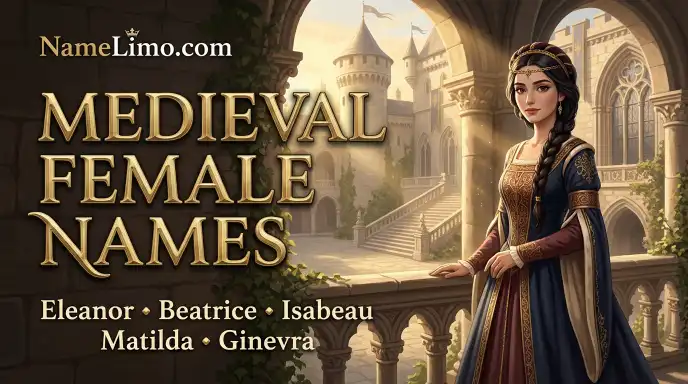
Medieval female names reflect the history, languages, and traditions of the Middle Ages. From elegant names used by European queens to simple names carried by village women, these choices can bring authenticity and character to historical stories, fantasy novels, games, and role playing characters.
This collection includes medieval English names, royal women’s names, French and German names, Celtic inspired choices, rare historical names, and fantasy names with a medieval feel.
Popular Medieval Female Names
These names were used in medieval Europe or are strongly associated with women from the period.
- Eleanor
- Matilda
- Margaret
- Alice
- Agnes
- Edith
- Joan
- Beatrice
- Isabella
- Catherine
- Cecily
- Philippa
- Constance
- Emma
- Anne
- Elizabeth
- Mary
- Juliana
- Maud
- Margaret
Royal Medieval Female Names
Royal names suit princesses, queens, noblewomen, and powerful female characters in historical fiction.
- Eleanor of Aquitaine
- Matilda of England
- Isabella of France
- Philippa of Hainault
- Margaret of Anjou
- Anne of Bohemia
- Blanche of Castile
- Berengaria of Navarre
- Adelaide of Italy
- Constance of Castile
- Joan of Navarre
- Yolande of Aragon
- Sibylla of Jerusalem
- Melisende of Jerusalem
- Ermengarde of Anjou
- Hedwig of Silesia
- Beatrice of Provence
- Ingeborg of Denmark
- Urraca of León
- Sancha of Castile
These examples include historical royal women. Some are full historical names rather than standalone given names.
Medieval English Female Names
Medieval English names reflect naming traditions from Anglo Saxon England and the later Middle Ages.
- Edith
- Eadgyth
- Æthelflæd
- Ælfgifu
- Godgifu
- Mildred
- Wulfrun
- Avice
- Amice
- Hawise
- Isolda
- Gunnora
- Muriel
- Rohese
- Lettice
- Sybil
- Joan
- Cecily
- Margery
- Emmeline
Spellings varied over time and across regions. Names such as Ælfgifu and Æthelflæd reflect Old English traditions, while Hawise and Rohese appear in medieval records.
Beautiful Medieval Girl Names
These names have a graceful sound and work well for historical characters, gentle heroines, and romantic fantasy settings.
- Amabel
- Aveline
- Clarice
- Isolde
- Rosamund
- Melisande
- Adelina
- Amice
- Elinor
- Emeline
- Alais
- Blanche
- Celestine
- Florentia
- Leonora
- Lucienne
- Ottilie
- Sibella
- Violante
- Ysabel
Some forms are historical variants, while others became more familiar in later periods. Their medieval use depends on the region and date.
Rare Medieval Female Names
These less familiar choices can help a character stand out while drawing on historical naming traditions.
- Athelina
- Eufemia
- Godeleva
- Helewise
- Ingeltrude
- Liutgard
- Mabel
- Odelina
- Petronilla
- Richeza
- Scholastica
- Theophania
- Wulfhild
- Xenia
- Ymma
- Almodis
- Ermengarde
- Heloise
- Isabeau
- Thomasse
Historical spelling and usage differ by language and century, so verify a name against the particular setting if accuracy is important.
Medieval French Female Names
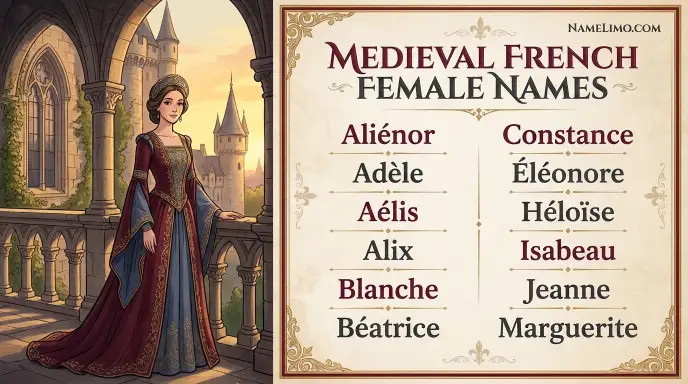
French names are excellent choices for noblewomen, courtly characters, and stories set in medieval France.
- Aliénor
- Adèle
- Agnès
- Aélis
- Alix
- Blanche
- Béatrice
- Constance
- Éléonore
- Ermengarde
- Esclarmonde
- Héloïse
- Isabeau
- Isabelle
- Jeanne
- Mahaut
- Marguerite
- Mélisende
- Pétronille
- Sibylle
These names reflect historical French forms and spelling traditions. Accents and spellings can vary in modern references.
Medieval German Female Names
Germanic naming traditions offer strong choices for noblewomen, queens, warriors, and characters in Central European settings.
- Adelheid
- Agnes
- Bertha
- Brunhild
- Gisela
- Hedwig
- Hildegard
- Irmingard
- Kunigunde
- Liutgard
- Mathilde
- Mechthild
- Oda
- Richenza
- Roswitha
- Sophia
- Theodora
- Uta
- Walburga
- Wiltrud
Medieval Celtic Female Names
Celtic names and legendary figures can suit stories set in Ireland, Wales, Scotland, or Celtic inspired fantasy worlds.
- Aoife
- Aisling
- Brigid
- Deirdre
- Eithne
- Grainne
- Niamh
- Rhiannon
- Siobhan
- Mairi
- Gwenllian
- Nest
- Angharad
- Elen
- Lowri
- Catrin
- Eleri
- Morwenna
- Isolde
- Olwen
Celtic languages have distinct histories and naming conventions. Some names in this list are traditional names, while others are associated with medieval literature or legend.
Medieval Italian Female Names
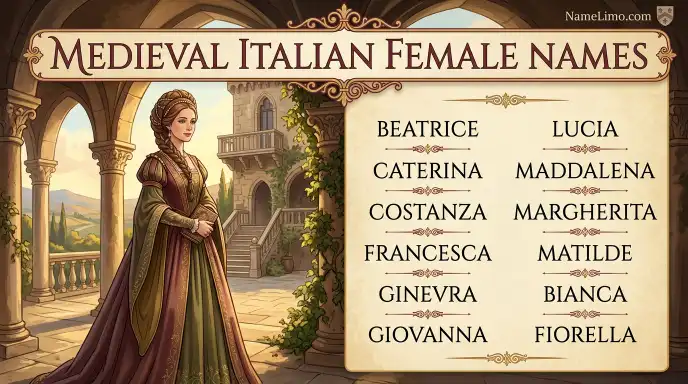
These names suit characters from medieval Italian cities, noble families, and historical romances.
- Beatrice
- Caterina
- Costanza
- Francesca
- Ginevra
- Giovanna
- Lucia
- Maddalena
- Margherita
- Matilde
- Paola
- Peronella
- Richelda
- Simona
- Teodora
- Agnese
- Antonia
- Bianca
- Fiorella
- Luchina
Some forms were used across several centuries, so their suitability depends on the exact period and location.
Medieval Spanish Female Names
Spanish medieval names are useful for characters from Castile, León, Navarre, Aragon, and other Iberian kingdoms.
- Urraca
- Sancha
- Elvira
- Jimena
- Berenguela
- Leonor
- Blanca
- Teresa
- Constanza
- Beatriz
- María
- Inés
- Aldonza
- Mayor
- Mencía
- Violante
- Toda
- Sancha
- Estefanía
- Isabel
Medieval Iberian names were influenced by different languages, regions, and religious communities. The exact form can change by historical context.
Medieval Scandinavian Female Names
These names draw on Old Norse and medieval Scandinavian traditions, making them suitable for Viking era stories and northern European settings.
- Astrid
- Sigrid
- Ingrid
- Thyra
- Gudrun
- Gunnhild
- Ragnhild
- Thora
- Helga
- Freydis
- Estrid
- Ragnfrid
- Svanhild
- Signy
- Hervor
- Alfhild
- Ylva
- Solveig
- Brynhild
- Aud
Some names are better associated with the Viking Age or Old Norse literature than with every part of the later Middle Ages.
Medieval Peasant and Commoner Female Names
These names work for village women, farmers’ daughters, craftspeople, servants, and ordinary townspeople in historical fiction.
- Alice
- Agnes
- Joan
- Margery
- Cecily
- Edith
- Emma
- Matilda
- Rose
- Isabel
- Katherine
- Beatrice
- Ellen
- Amice
- Avice
- Hawise
- Juliana
- Lucy
- Maud
- Sybil
Names alone did not determine social class. Many names were used by women from different backgrounds, and naming patterns varied by place and period.
Medieval Warrior Woman Names
These names suit female knights, shieldmaidens, rebel leaders, and brave heroines in historical or fantasy settings.
- Æthelflæd
- Matilda
- Joan
- Eleanor
- Ragnhild
- Gunnhild
- Brynhild
- Hervor
- Freydis
- Hildegard
- Isolde
- Alfhild
- Sigrid
- Maud
- Urraca
- Gwenllian
- Melisende
- Tomoe
- Kishi
- Mulan
The list mixes historical women, legendary figures, and names from other cultural traditions. Tomoe and Mulan, for example, are associated with Japanese and Chinese traditions rather than medieval European naming.
Medieval Fantasy Female Names
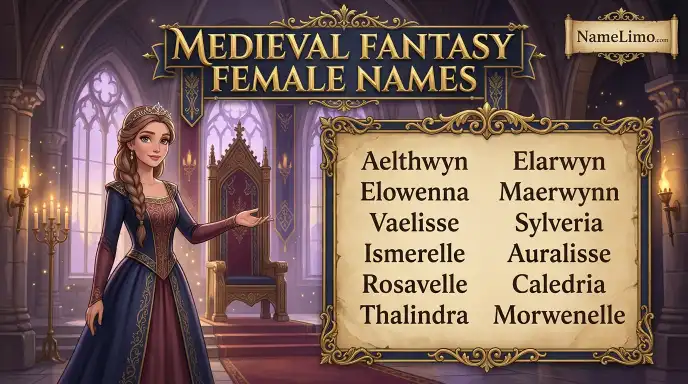
For a fictional kingdom, magical court, or medieval inspired role playing game, these invented names offer a more imaginative style.
- Aelthwyn
- Elowenna
- Vaelisse
- Ismerelle
- Rosavelle
- Thalindra
- Elarwyn
- Maerwynn
- Sylveria
- Auralisse
- Caledria
- Elsinora
- Virellia
- Morwenelle
- Aramelle
- Ysmeria
- Valewyn
- Serelinde
- Avenora
- Melanwy
These are fantasy creations, not verified historical medieval names.
Dark Medieval Female Names
Dark and dramatic names can suit gothic fiction, cursed noblewomen, mysterious healers, and morally complex characters.
- Morgause
- Morgan
- Isolde
- Melisande
- Ravenna
- Morwen
- Sybilla
- Ysoria
- Aveline
- Heloise
- Noctelle
- Velmora
- Ebonelle
- Thornwyn
- Malveria
- Vespera
- Corvella
- Ashmira
- Nightwyn
- Belladrya
The final names are invented or fantasy inspired. They should not be treated as documented medieval names without further evidence.
Medieval Female Names With Meanings
Meanings can vary by language, spelling, and historical interpretation. The following are widely cited name meanings rather than guaranteed meanings for every medieval use.
| Name | Commonly cited meaning or origin |
| Eleanor | Meaning is debated; associated with medieval European royalty |
| Matilda | Germanic name meaning “strength in battle” |
| Margaret | From Greek, meaning “pearl” |
| Agnes | From Greek, traditionally interpreted as “pure” |
| Edith | Old English elements associated with wealth and battle |
| Alice | Related to Old French forms of Adelaide |
| Beatrice | From Latin, associated with blessing or happiness |
| Isabella | Medieval form related to Elizabeth |
| Catherine | Traditionally associated with the meaning “pure” |
| Hildegard | Germanic elements associated with battle and protection |
| Adelaide | Germanic name meaning “noble” or “of noble kind” |
| Rose | Derived from the name of the flower |
| Clara | From Latin, meaning “clear” or “bright” |
| Sophia | From Greek, meaning “wisdom” |
| Emma | Germanic name associated with the element ermen, meaning whole or universal |
How to Choose a Medieval Female Name
The best name depends on the character’s location, social position, and the century in which your story takes place.
- Choose the region: Use English names for an English setting, French names for medieval France, or Norse names for Scandinavian stories.
- Match the character’s role: Royal characters may suit names such as Eleanor or Matilda, while a village character might be called Alice, Agnes, or Joan.
- Check the time period: The early Middle Ages and late Middle Ages had different naming patterns.
- Use historically suitable spelling: A modern spelling may differ from the form found in medieval documents.
- Separate history from fantasy: Invented names can work beautifully in fictional kingdoms, but label them as fantasy choices rather than historical facts.
Frequently Asked Questions
1. What were common female names in medieval times?
Alice, Agnes, Joan, Margaret, Matilda, Edith, Emma, and Cecily were used in medieval Europe. Exact popularity varied across regions and centuries.
2. What is a beautiful medieval female name?
Eleanor, Isolde, Aveline, Melisande, Beatrice, and Rosamund are elegant choices associated with medieval or medieval inspired naming traditions.
3. What are rare medieval girl names?
Helewise, Rohese, Godeleva, Liutgard, Richeza, and Petronilla are less familiar choices with historical associations. Check regional records if you need a name for a specific century.
4. What were medieval princesses called?
Princesses and royal women often used names such as Eleanor, Isabella, Matilda, Philippa, Blanche, and Margaret. Their full names could also include titles, family relationships, or place based designations.
5. What are good medieval names for a female warrior?
Æthelflæd, Gwenllian, Matilda, Ragnhild, Hervor, and Freydis are suitable starting points. Some are associated with historical women, while others come from legend or saga traditions.
6. What is a good medieval fantasy name for a girl?
Aelthwyn, Vaelisse, Elsinora, Maerwynn, and Serelinde are original fantasy style options. They sound medieval inspired without claiming to be documented historical names.
7. How can I find an authentic medieval female name?
Start with the region and century of your character, then consult historical records, specialist name dictionaries, or academic studies of medieval naming. Avoid assuming that a name used in one European country was common across the entire Middle Ages.
Final Thoughts
Medieval female names range from familiar choices such as Alice and Margaret to royal names such as Eleanor and Matilda, as well as regional forms like Rhiannon, Adelheid, and Urraca. For fantasy writing, invented names can offer extra freedom while retaining a medieval atmosphere.
Choose a name that fits your character’s culture and time period, and verify its historical background if accuracy matters.
Read More Names

I’m Olivia Bennett, the author behind namelimo.com, where I research names, their meanings, origins, and cultural connections to create simple, helpful naming guides. My goal is to uncover the stories behind names and help readers find one that feels meaningful and memorable.