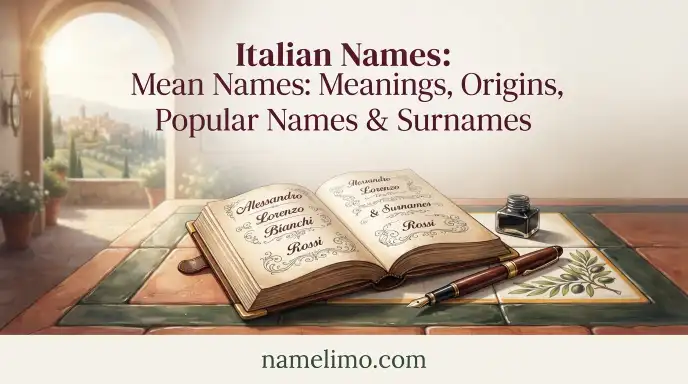
Italian names include a rich mix of Roman, Latin, Greek, Germanic, Christian, regional, and literary influences.
Popular choices today include Leonardo, Edoardo, Tommaso, Sofia, Aurora, Ginevra, Vittoria, and Giulia, while older names such as Francesco, Maria, Giuseppe, Antonio, and Anna remain strongly connected with Italian naming history.
If you are researching a traditional Italian given name, looking for a modern baby name, exploring an Italian surname, or simply interested in Italian naming culture, this guide covers the main patterns, meanings, history, and regional influences.
What Are Italian Names?
Italian names are personal names and family names used in Italy and within Italian-speaking communities.
They have developed through many layers of history, including ancient Italic languages, Latin and Roman naming, Greek influence, Germanic names introduced during the medieval period, Christianity, local traditions, and later literary revivals.
This means that an Italian name is not always originally “Italian” in the narrow linguistic sense.
A name may have entered Italian through Latin, Greek, Hebrew, Germanic languages, or another historical tradition and later become firmly established in Italian usage.
Popular Italian Boy Names
Recent birth data provides a useful picture of contemporary Italian naming preferences. According to Italy’s national statistics institute, ISTAT, Leonardo was the most frequently chosen boys’ name for babies born in 2024, followed by Edoardo, Tommaso, Mattia, and Alessandro.
| Name | Common association |
| Leonardo | Traditional Italian form with strong historical and artistic associations |
| Edoardo | Italian form related to Edward |
| Tommaso | Italian form of Thomas |
| Mattia | Italian form related to Matthew |
| Alessandro | Italian form of Alexander |
| Francesco | Strong Christian and Italian tradition |
| Lorenzo | Traditional name with Latin roots |
| Matteo | Italian form of Matthew |
| Luca | Long-established Italian name |
| Andrea | Traditional Italian masculine usage |
Popularity changes over time, so a name that is common today may not have been equally popular in previous generations.
Popular Italian Girl Names
For girls born in Italy in 2024, Sofia ranked first nationally. It was followed by Aurora, Ginevra, Vittoria, and Giulia.
| Name | Common association |
| Sofia | Internationally familiar and long established in Italy |
| Aurora | Associated with dawn and the Roman goddess Aurora |
| Ginevra | Traditional Italian form of Guinevere |
| Vittoria | Connected with the Latin word for victory |
| Giulia | Italian form related to Julia |
| Beatrice | Literary and historical Italian name |
| Alice | Widely used in modern Italy |
| Chiara | Italian name associated with clarity or brightness |
| Anna | Long-standing biblical and Christian tradition |
| Maria | One of the most historically important names in Italy |
Current popularity should not be confused with overall historical frequency. A name can be culturally important for centuries without being among the most frequently given to newborns today.
ISTAT’s official Conta Nomi tool provides birth-name data from 1999 through the latest available year and allows users to examine individual names and yearly rankings.
What Are the Most Traditional Italian Names?
Some Italian names have remained recognizable across many generations because of family tradition, Christianity, saints, local devotion, and historical usage.
Traditional examples include:
Boys
- Giuseppe
- Giovanni
- Francesco
- Antonio
- Pietro
- Paolo
- Carlo
- Luigi
- Domenico
- Marco
Girls
- Maria
- Anna
- Lucia
- Caterina
- Teresa
- Rosa
- Angela
- Francesca
- Giovanna
- Paola
Treccani notes that family and religious traditions have played a major role in Italian naming, with names connected to saints and the Virgin Mary especially important in the traditional repertoire.
Where Do Italian Names Come From?
Italian names have several major historical sources.
Latin and Roman Names
Ancient Rome contributed a large group of names that remain recognizable in Italian.
Examples include:
- Marco
- Claudio
- Giulio
- Fabio
- Emilio
- Flavio
- Adriano
- Augusto
- Sergio
- Valerio
The history is not limited to names that originated in Latin. Roman society also adopted names from peoples and cultures it encountered. Treccani identifies Etruscan, Greek, Sabine, Oscan, and other influences in the ancient Italian name pool.
Greek Names
Greek influence entered Italian naming through ancient contact with Greek-speaking communities and later through Christianity and classical culture.
Examples include:
- Alessandro
- Filippo
- Giorgio
- Elena
- Andrea
- Stefano
- Sebastiano
- Sofia
Germanic Names
Medieval Italy also absorbed names of Germanic origin.
Examples include:
- Alberto
- Roberto
- Federico
- Enrico
- Guglielmo
- Guido
- Bernardo
These names became part of the broader Italian naming system even though their original linguistic roots are Germanic.
Christian and Biblical Names
Christianity had a major effect on Italian personal names.
Examples include:
- Giovanni
- Giuseppe
- Maria
- Anna
- Matteo
- Luca
- Marco
- Pietro
- Paolo
- Francesco
Religious tradition was particularly influential in shaping the historical Italian name repertoire.
Literary and Classical Revival
The Renaissance brought renewed interest in ancient Greek and Roman culture. As classical texts were rediscovered, names associated with ancient history, mythology, and literature returned to use.
Examples include:
- Achille
- Ettore
- Elena
- Enea
- Ulisse
- Oreste
- Romolo
- Remo
Treccani describes this Renaissance revival as an important stage in the development of the Italian personal-name repertoire.
Italian Names and Regional Traditions
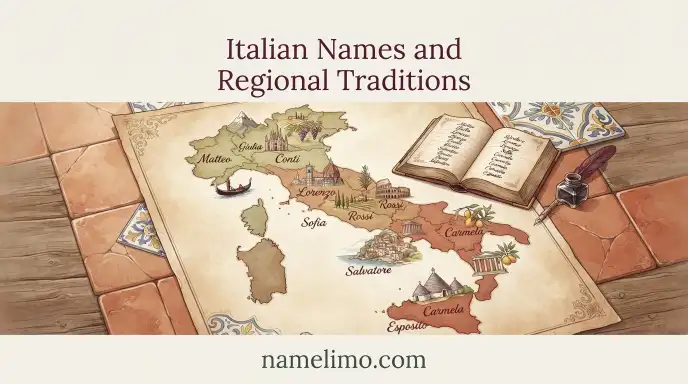
Italian naming is not completely uniform across the country.
Different regions developed distinctive linguistic traditions, dialects, saints’ cults, local customs, and naming preferences. A name that is especially traditional in one area may be less common elsewhere.
For example, ISTAT’s 2024 birth data shows regional differences even among the most popular contemporary names. Leonardo led in much of northern and central Italy, while different names topped the rankings in several southern regions.
Regional identity can therefore be an important part of understanding an Italian name.
Italian Nicknames and Short Forms
Italian names often have shortened or affectionate forms. These forms can sometimes become names in their own right or even contribute to surnames.
Examples include:
| Full name | Possible short form |
| Giovanni | Gianni |
| Francesco | Franco |
| Giuseppe | Beppe |
| Antonio | Tonio |
| Alessandro | Sandro |
| Leonardo | Leo |
| Domenico | Mimmo |
| Tommaso | Tommi |
| Elisabetta | Betta |
| Francesca | Franca |
However, short forms vary by region, family, period, and individual preference. They should not always be treated as fixed equivalents.
Treccani documents many historical Italian surname forms that developed from shortened or affectionate versions of personal names.
How Did Italian Surnames Develop?
Italian surnames have a particularly diverse history. Many developed from descriptions, occupations, places, personal names, nicknames, or family relationships.
A surname could originally identify someone as:
- The child of a particular person
- A person from a particular place
- Someone with a particular physical characteristic
- Someone associated with an occupation
- A member of a particular family
- Someone known by a nickname
The hereditary surname system developed gradually. Treccani notes that Italian surnames began appearing in a more recognizable form around the 12th century and became more firmly established during the later medieval period.
Common Types of Italian Surnames
Patronymic Surnames
These are connected to a father’s or ancestor’s personal name.
Examples of surname families may include forms derived from names such as Giovanni, Pietro, or Francesco.
Treccani identifies patronymic and matronymic formation as important sources of Italian surnames.
Occupational Surnames
Some surnames developed from occupations or trades.
These names can reflect the work associated with an ancestor.
Locational Surnames
A surname may indicate where a person or family came from.
Examples include surnames connected with places such as:
- Milano
- Napoli
- Palermo
- Salerno
- Messina
- Catania
Italian surname research has found a substantial number of surnames derived from place names.
Nickname-Based Surnames
A physical trait, personality characteristic, or distinguishing nickname could eventually become hereditary.
Rossi is a well-known example. Treccani explains that it is connected with rosso, “red,” historically used as a nickname, and identifies Rossi as the most common Italian surname in its discussion.
Why Are There So Many Italian Surnames?
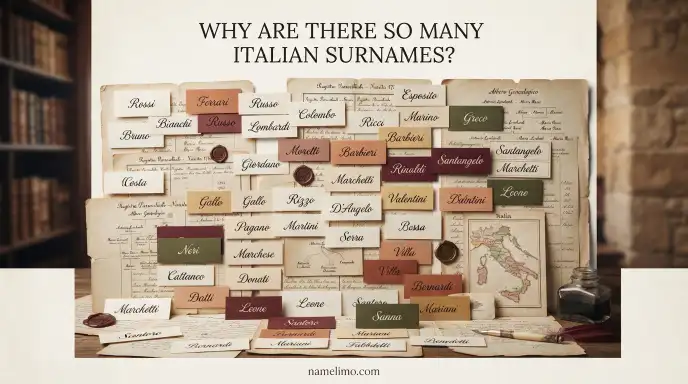
Italy has an unusually diverse surname heritage. Treccani estimates roughly 400,000 Italian surnames, linking this diversity to Italy’s historical linguistic fragmentation, regional dialects, different administrative traditions, and varied surname-formation patterns.
This diversity also explains why two surnames can have related origins but look quite different.
Small differences in vowels, consonants, suffixes, or dialect forms could become fixed in official records over time.
Italian Names With Strong Historical Connections
Some names stand out because of their association with major figures, literature, religion, or Italian cultural history.
Leonardo
Leonardo is strongly associated with Leonardo da Vinci and remains a very popular contemporary boys’ name. It ranked first among boys born in Italy in 2024.
Dante
Dante is strongly connected with Dante Alighieri, author of the Divine Comedy. The name therefore has a particularly strong literary association in Italian culture.
Francesco
Francesco has a long religious tradition in Italy, especially through Francis of Assisi. Treccani identifies religious and saintly traditions as major forces behind the continued use of traditional Italian names.
Beatrice
Beatrice has a major place in Italian literary history through Dante’s portrayal of Beatrice in the Divine Comedy.
Giulio and Giulia
These names connect modern Italian usage with the ancient Roman name Iulius and its feminine form Iulia.
Italian Names From Literature and Mythology
Italian culture has preserved and revived many names associated with classical literature, mythology, and later Italian literature.
Examples include:
- Enea
- Achille
- Ettore
- Ulisse
- Elena
- Arianna
- Diana
- Penelope
- Dante
- Beatrice
- Laura
- Orlando
These names can have different histories. Some entered Italian through ancient traditions, while others gained popularity through literary works.
Treccani specifically notes the revival of classical names such as Achille, Ettore, Elena, Enea, Oreste, and Ulisse during the Renaissance.
Are Italian Names Usually Religious?
Historically, many were, but modern Italian naming is much more varied.
Religious names such as Maria, Giuseppe, Giovanni, Francesco, Antonio, and Anna have deep roots in Italian culture. However, modern parents also choose names influenced by literature, international culture, popular media, family preferences, and newer naming trends.
Treccani notes a long-term decline in some traditional religious naming practices alongside secularization and changing family and social patterns.
So it is more accurate to say that religion is one major historical influence on Italian names, not a requirement for an Italian name.
Modern Italian Names vs. Traditional Italian Names
| Feature | Traditional choices | Modern choices |
| Main influences | Family, saints, religion | Culture, fashion, media, international use |
| Examples | Giuseppe, Maria, Giovanni | Ginevra, Leonardo, Aurora |
| Regional influence | Often strong | Still important |
| International use | Varies | Often more important |
| Historical connection | Usually strong | Can range from ancient to contemporary |
The categories overlap. A name can be both traditional and fashionable at the same time.
How Popular Are Italian Names Today?
Popularity depends on the period being measured.
For newborns, ISTAT provides official yearly data. In 2024, the top five boys’ names were Leonardo, Edoardo, Tommaso, Mattia, and Alessandro. The top five girls’ names were Sofia, Aurora, Ginevra, Vittoria, and Giulia.
For longer-term research, ISTAT’s name counter covers births registered from 1999 through the latest available year, making it useful for checking if a name is rising, declining, or remaining relatively stable.
How to Choose an Italian Name
If you are choosing an Italian name, start with the reason behind the choice.
For a Traditional Feel
Consider names with long-standing Italian or Christian use, such as:
- Giovanni
- Francesco
- Giuseppe
- Maria
- Anna
- Lucia
For a Modern Italian Feel
Consider names that are currently prominent among Italian newborns, such as:
- Leonardo
- Edoardo
- Tommaso
- Sofia
- Aurora
- Ginevra
Current popularity data can help if you want a name that feels contemporary in Italy.
For a Literary Feel
Names such as:
- Dante
- Beatrice
- Laura
- Orlando
- Arianna
can create stronger literary associations.
For an Ancient Feel
Consider:
- Giulio
- Giulia
- Marco
- Claudio
- Elena
- Enea
- Romolo
These connect more clearly with the classical or Roman tradition.
Italian Names for Boys
Here is a broader selection of Italian boy names:
- Alessandro
- Andrea
- Antonio
- Carlo
- Claudio
- Dante
- Davide
- Domenico
- Edoardo
- Enrico
- Federico
- Filippo
- Francesco
- Gabriele
- Giorgio
- Giovanni
- Giuseppe
- Leonardo
- Lorenzo
- Luca
- Marco
- Matteo
- Michele
- Paolo
- Pietro
- Riccardo
- Roberto
- Stefano
- Tommaso
- Vincenzo
Italian Names for Girls
Popular and traditional options include:
- Alessia
- Alice
- Anna
- Beatrice
- Bianca
- Camilla
- Caterina
- Chiara
- Cristina
- Elena
- Elisa
- Elisabetta
- Francesca
- Ginevra
- Giulia
- Lucia
- Maria
- Martina
- Paola
- Rosa
- Sara
- Sofia
- Teresa
- Valentina
- Vittoria
Italian Names With a Distinctive Style
If you want something less ordinary, you can look beyond current top rankings.
Examples include:
Boys:
Tancredi, Ascanio, Raffaele, Corrado, Ludovico, Orlando, Cesare, Emanuele
Girls:
Eulalia, Leonetta, Allegra, Fiorella, Livia, Ottavia, Costanza, Violetta
Rare does not necessarily mean newly invented. Some uncommon Italian names are old names that are simply used less often today.
ISTAT’s reporting has documented names such as Eulalia, Tancredi, Ascanio, Desdemona, Leonetta, and Edmondo among recent births, showing that older and uncommon choices remain in use.
Frequently Asked Questions About Italian Names
1. What are the most popular Italian names?
For babies born in Italy in 2024, Leonardo was the leading boys’ name and Sofia was the leading girls’ name. Edoardo and Tommaso followed among boys, while Aurora and Ginevra followed among girls.
2. What is a classic Italian boy name?
Giovanni, Giuseppe, Francesco, Antonio, Pietro, Carlo, and Paolo are examples of long-established Italian male names. Their historical importance comes from family, religious, and cultural traditions.
3. What is a classic Italian girl name?
Maria, Anna, Lucia, Caterina, Teresa, Rosa, and Angela are examples of traditional Italian female names.
4. Are Italian names always derived from Latin?
No. Italian names come from several historical sources. Latin and Roman names are important, but Greek, Germanic, Hebrew, Christian, local, and literary influences also contributed to the Italian repertoire.
5. What is the difference between an Italian name and a name used in Italy?
A name can be used in Italy without being of Italian origin. For example, Italy has historically adopted names from Greek, Germanic, Hebrew, and other linguistic traditions. “Italian name” can therefore describe established Italian usage as well as strictly Italian linguistic origin.
6. How can I check how common an Italian name is?
ISTAT’s official name counter lets you search individual names and view birth data from 1999 through the latest available year.
7. What are common Italian surnames?
Examples include Rossi, Russo, Ferrari, Esposito, Bianchi, Romano, Colombo, Ricci, Marino, and others. Surname frequency can vary greatly by region, and national frequency does not necessarily indicate the historical origin of a particular family.
8. Why do Italian surnames have so many different forms?
Italy’s historical dialect diversity, different local naming practices, varied suffixes, and gradual standardization all contributed to the large number of surname forms found today.
Final Thoughts
Italian names reflect much more than one naming tradition. They preserve layers of Roman history, Christianity, medieval culture, regional languages, literature, and modern social change.
If you are choosing a name, researching family history, or studying Italian onomastics, it helps to look at origin, regional use, historical context, and current popularity together.
For current popularity, official ISTAT data is the most useful starting point; for historical and linguistic background, Treccani provides detailed Italian onomastic research.
Read more:

I’m Grace Anderson, a name researcher and the writer behind NameLimo. I love discovering unique and meaningful names for babies, pets, characters, and businesses, helping readers find the perfect name with confidence.