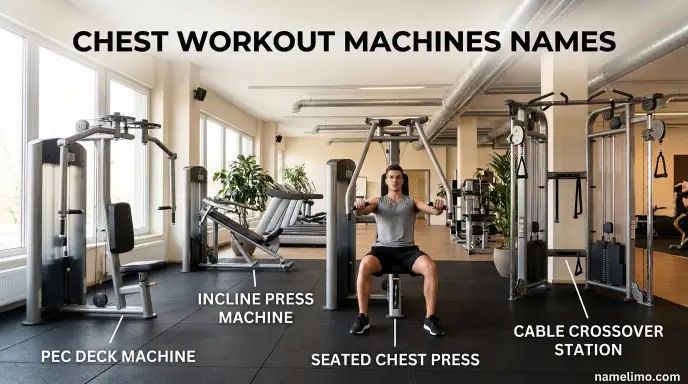
Chest workout machines help train the pectoral muscles, improve pressing strength, and build upper body muscle.
Common chest machines include the chest press machine, pec deck, cable crossover, Smith machine, and incline chest press machine. Each machine targets the chest from a slightly different angle, making it easier to build a balanced workout.
If you are new to the gym or looking to improve your training routine, this guide explains the names of chest workout machines, how they work, and which chest muscles they target.
Chest Workout Machines Names Guide
The following machines are commonly found in commercial gyms. Their designs can vary by brand, but their main training purposes are similar.
1. Chest Press Machine
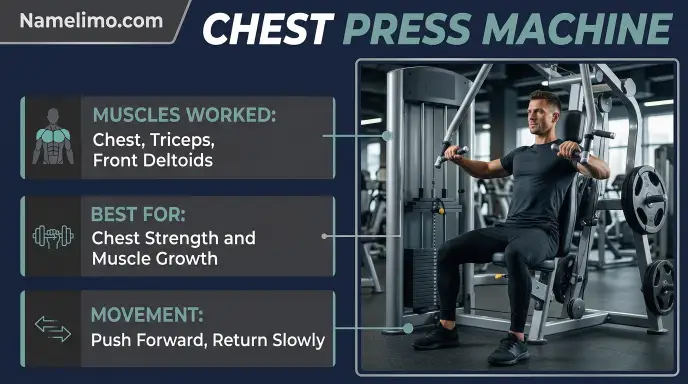
The chest press machine is one of the most common gym machines for chest training. You sit against a padded backrest and push the handles forward.
- Main muscles worked: Pectoralis major, triceps, and front deltoids.
- Best for: Building general chest strength and muscle.
- How it works: Push the handles away from your chest, then return slowly without letting the weights drop.
2. Incline Chest Press Machine
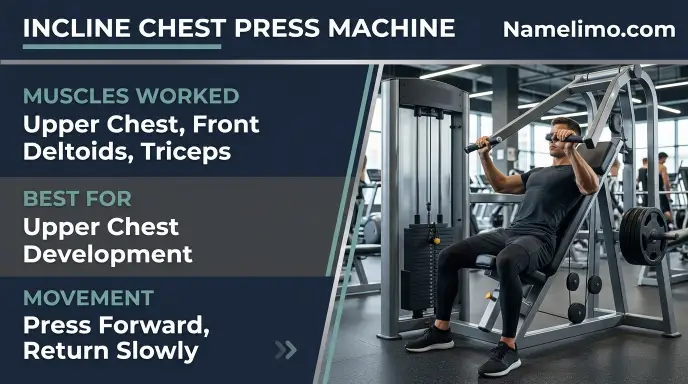
The incline chest press machine uses an angled pressing movement to emphasize the upper portion of the chest.
- Main muscles worked: Upper chest, front deltoids, and triceps.
- Best for: Developing the upper chest.
- How it works: Adjust the seat so the handles begin around the upper chest level, then press forward and return under control.
3. Decline Chest Press Machine
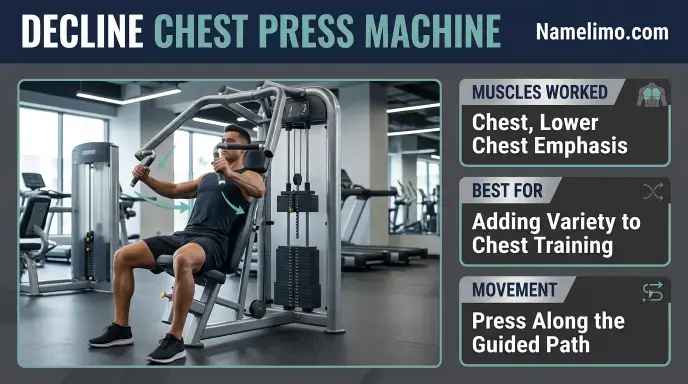
The decline chest press machine positions the pressing path to emphasize the lower portion of the chest.
- Main muscles worked: Pectoralis major, with emphasis on its lower or sternocostal region.
- Best for: Adding variety to chest training.
- How it works: Press the handles along the machine’s guided path while keeping your shoulders comfortably positioned.
4. Pec Deck Machine
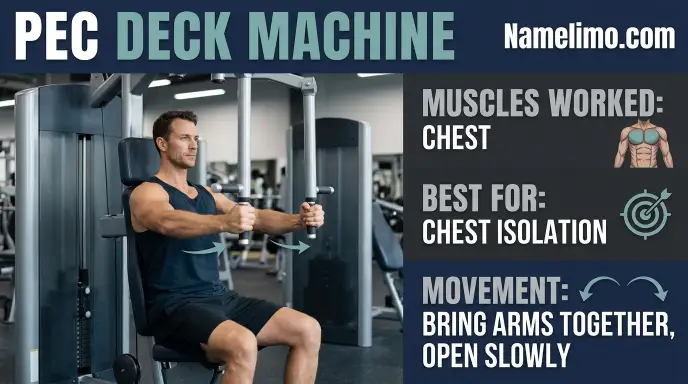
The pec deck, also called a chest fly machine, brings your arms together in front of your body. Depending on the model, you may use forearm pads or handles.
- Main muscles worked: Pectoralis major.
- Best for: Chest isolation and controlled fly movements.
- How it works: Bring the pads or handles together without shrugging your shoulders, then slowly open your arms.
5. Cable Crossover Machine
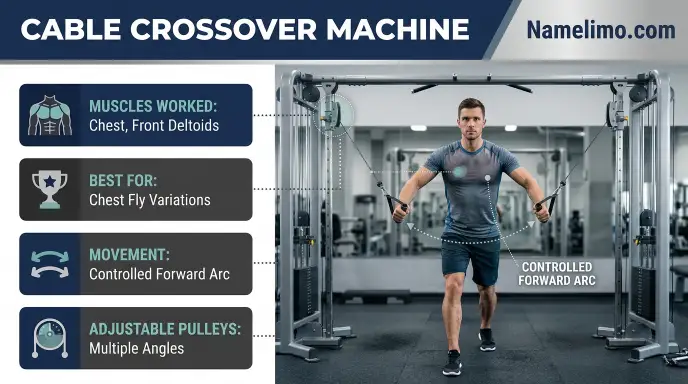
The cable crossover station has adjustable pulleys on two sides. It allows chest exercises from several angles.
- Main muscles worked: Pectoralis major, front deltoids, and supporting muscles.
- Best for: Chest fly variations and adjustable resistance.
- How it works: Hold one handle in each hand and bring your arms forward in a controlled arc. Adjust the pulley height to change the movement angle.
6. Smith Machine
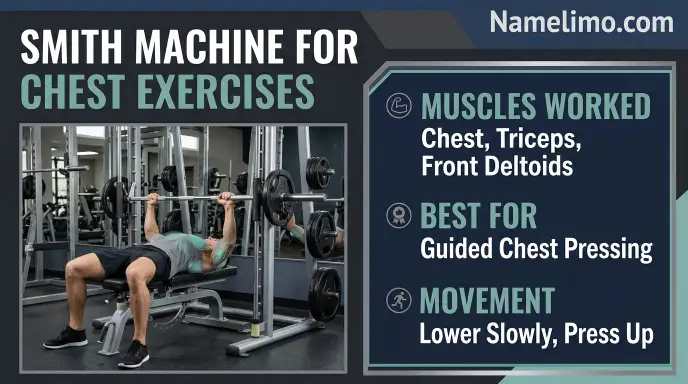
The Smith machine has a bar that moves along fixed vertical or slightly angled rails. It can be used for bench presses and incline presses with a suitable bench.
- Main muscles worked: Chest, triceps, and front deltoids during pressing exercises.
- Best for: Guided barbell style chest pressing.
- How it works: Set the bench and safety stops correctly, lower the bar under control, and press it back up.
7. Incline Smith Machine Press Setup
This is not a separate machine. It is an incline bench positioned inside a Smith machine to perform an incline press.
- Main muscles worked: Upper chest, front deltoids, and triceps.
- Best for: Guided upper chest training.
- How it works: Position the bench so the bar travels comfortably toward the upper chest, and set the safety stops before lifting.
8. Plate Loaded Chest Press Machine
This machine uses weight plates rather than a selectorized weight stack. Many models have independent handles for each arm.
- Main muscles worked: Chest, triceps, and front deltoids.
- Best for: Heavier pressing and independent arm variations.
- How it works: Load the machine evenly, secure the plates, and press the handles through a comfortable range of motion.
9. Converging Chest Press Machine
A converging chest press has handles that move inward toward one another as you press. Some standard chest press machines use this design.
- Main muscles worked: Chest, triceps, and front deltoids.
- Best for: A pressing movement that follows a natural inward path.
- How it works: Press forward as the handles move toward the center, keeping your shoulders down and controlled.
10. Dual Action Chest Press Machine
Some machines allow each arm to move independently. This can help you notice strength differences between the left and right sides.
- Main muscles worked: Chest, triceps, and front deltoids.
- Best for: Balanced pressing practice and unilateral training.
- How it works: Press each handle evenly, avoiding twisting or shifting your torso.
11. Functional Trainer
A functional trainer is a cable station with two adjustable pulleys. It is useful for standing chest presses, cable flyes, and other upper body movements.
- Main muscles worked: Chest and supporting shoulder and arm muscles.
- Best for: Flexible chest exercises and different movement angles.
- How it works: Adjust both pulleys to the required height, select a manageable weight, and perform a controlled press or fly.
12. Cable Pulley Station
A single or dual cable pulley station can be used for several chest exercises, depending on its attachments and setup.
- Main muscles worked: Chest, triceps, and front deltoids.
- Best for: Cable presses and fly variations.
- How it works: Use an appropriate handle attachment and keep the cable tension controlled throughout the movement.
13. Assisted Dip Machine
The assisted dip machine uses a counterweight to reduce the amount of body weight you lift during dips. A forward torso lean can increase chest involvement.
- Main muscles worked: Chest, triceps, and front deltoids.
- Best for: Practicing dips with assistance.
- How it works: Set the assistance level, stabilize your body, and lower only as far as your shoulders comfortably allow.
14. Seated Dip Machine
The seated dip machine is a machine where you push handles down, which trains the lower chest and the back of the arms.
Main muscles worked: Lower chest and the back of the arms.
Best for: Lower chest pressing with a down press movement.
How it works: Push the handles down in a controlled movement, then return slowly.
15. Chest Supported Press Machine
Some gyms have specialized chest press machines with a supported torso and independent pressing arms. The exact name varies by manufacturer.
- Main muscles worked: Chest, triceps, and front deltoids.
- Best for: Stable pressing without needing to balance free weights.
- How it works: Keep your back against the support and press the handles without lifting your shoulders.
16. Multi Press Machine
A multi press machine may allow flat, incline, or shoulder pressing through adjustable seats, handles, or backrests.
- Main muscles worked: Depends on the selected pressing angle.
- Best for: Gyms with limited floor space or users who want several pressing options.
- How it works: Follow the machine’s adjustment instructions and confirm the handles are aligned for the chosen exercise.
Chest Workout Machines Comparison
| Machine name | Main chest emphasis | Common exercise |
| Chest press machine | Overall chest | Seated chest press |
| Incline chest press | Upper chest | Incline press |
| Decline chest press | Lower chest emphasis | Decline press |
| Pec deck | Chest isolation | Machine fly |
| Cable crossover | Chest from varied angles | Cable fly |
| Smith machine | Depends on bench angle | Bench press |
| Plate loaded chest press | Overall chest | Loaded press |
| Converging chest press | Overall chest | Converging press |
| Functional trainer | Depends on cable angle | Cable press or fly |
| Assisted dip machine | Chest and triceps | Assisted dip |
The amount of emphasis on each chest region depends on the machine’s design, seat position, arm path, and your technique. No machine isolates one part of the chest completely.
Chest Workout Machines Names by Chest Area
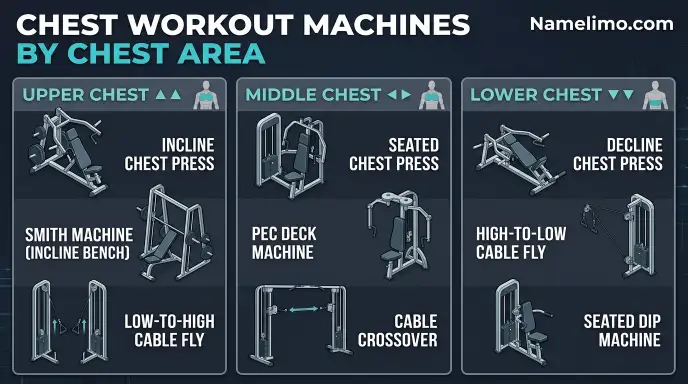
The chest is one main muscle with fibers that run in more than one direction. Angle changes which fibers work more. An upward press angle stresses the upper part more. A downward angle stresses the lower part more. A flat angle sits in the middle.
Best Machines for Upper Chest
- Incline Chest Press Machine, the top pick for a guided upper chest press
- Smith Machine with an incline bench, a guided way to press at an upward angle
- Low to high cable fly on a functional trainer, a cable move where the handles travel up and in
- Incline plate loaded press, a heavy option for lifters who want more load
Best Machines for Middle Chest
- Chest Press Machine, the main flat press option in most gyms
- Pec Deck Machine, a focused fly for the middle chest
- Cable Crossover Machine at chest height, a smooth fly with steady tension
- Iso Lateral Chest Press Machine, a strong press that lets each side work alone
Machines for Lower Chest
- Decline Chest Press Machine, the main guided press for the lower chest
- High to low cable crossover, a cable fly where the handles travel down and in
- Seated Dip Machine, a down press that also trains the arms
- Assisted Dip Machine, a supported dip option for lifters who are still building strength
Which Chest Workout Machine Is Best?
The best machine depends on your training goal and experience.
Best Machine for Building Chest Muscle
The chest press machine is a strong starting option because it provides a stable pressing movement. You can also use an incline chest press and a pec deck to add variety.
Best Machine for Upper Chest
The incline chest press machine is a practical choice for emphasizing the upper chest. A Smith machine with an incline bench can provide another option.
Best Machine for Chest Isolation
The pec deck is a common choice for chest flyes. Cable crossovers also work well if you want to adjust the direction of resistance.
Best Machine for Beginners
A selectorized chest press machine is often beginner friendly because you can change the resistance quickly and follow a guided movement path.
Best Machine for Training at Different Angles
A functional trainer or cable crossover station offers the most flexibility for changing cable height and performing different chest exercises.
Chest Workout Machines for Gym and Home
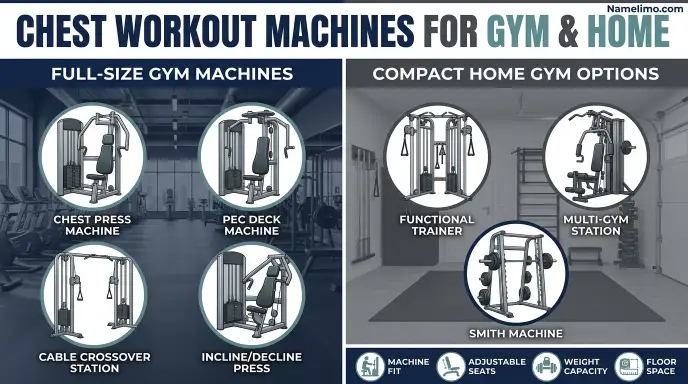
Gym machines are large and built for many users each day. Home machines need to save space and still give a good workout. The best home pick is often one machine that can do many moves.
Full Size Gym Machines
Most full gyms have a chest press, a pec deck, and a cable crossover station. Larger gyms also add incline and decline press machines. Some add plate loaded and iso lateral machines. This mix lets you train the full chest in one place.
Compact Home Gym Options
A functional trainer is the most flexible home pick. It can do cable fly moves, cable presses, and many other upper body moves. A multi gym station can add a chest press and a pec deck in one frame. A Smith machine needs more space, but it can support many press moves in one setup.
What to Check Before You Buy
Check the seat range and the handle path. Check the max weight and the frame strength. And also check the floor space with the machine in use, not just at rest. A machine that fits your body will feel smooth. A poor fit can push your shoulders into a bad spot.
Common Mistakes on Chest Machines
Small setup errors can take work away from the chest. The shoulders may take over. The weight may move too fast. A few simple fixes can make each rep feel much better.
Mistakes That Reduce Chest Work
- Using a weight that is too heavy to control
- Setting the seat too high or too low
- Letting the shoulders roll forward at the start
- Bouncing the weight at the bottom of the move
- Cutting the move short and missing the stretch
- Holding your breath for the full set
Simple Fixes That Help
Lower the weight until the path feels smooth. Set the seat before you start the set. Keep your chest up and your shoulder blades set on the pad. Move with control in both directions. Breathe out as you push or pull the handles together. Rest when your form starts to slip.
Safety Points for Machine Training
Use safety stops on a Smith machine when they are present. Keep hands and clothes clear of moving stacks and plates. Stop a set if you feel sharp pain. This guide gives general training information and it is not medical advice. Talk to a qualified health professional about pain or an injury.
How to Use Chest Machines Safely
Good technique matters more than lifting the heaviest weight. Follow these basic guidelines when using chest workout machines.
- Adjust the seat: Position the handles around chest level for a standard chest press.
- Start with manageable resistance: Choose a weight you can control through the full movement.
- Keep your back supported: Avoid excessive arching or lifting your shoulders toward your ears.
- Move slowly: Do not let the weight stack slam or allow the handles to pull your arms backward too far.
- Use a comfortable range: Stop if a movement causes sharp pain or uncomfortable shoulder pressure.
- Follow machine instructions: Different brands have different adjustments and safety features.
- Ask for guidance: If you are unsure how to set up a machine, ask a qualified gym trainer to demonstrate it.
Sample Chest Workout Using Machines
This simple example combines pressing and fly movements. Adjust the load and number of sets to your experience and recovery.
| Exercise | Sets | Repetitions |
| Chest press machine | 3 | 8–12 |
| Incline chest press machine | 3 | 8–12 |
| Pec deck machine | 2–3 | 10–15 |
| Cable crossover | 2 | 10–15 |
Rest around 1–3 minutes between sets, depending on the effort required and your fitness level. You do not need to use every chest machine in one workout. Start with a manageable amount of training and increase it gradually as your technique and recovery improve.
Frequently Asked Questions
1. What are the names of chest workout machines?
Common names include the chest press machine, incline chest press machine, decline chest press machine, pec deck, cable crossover, Smith machine, plate loaded chest press, and functional trainer.
2. Which gym machine works the chest the most?
The chest press machine is a useful choice for general chest training. The pec deck and cable crossover emphasize fly movements, while an incline press places more emphasis on the upper chest.
3. What is the machine called where you bring your arms together?
It is usually called a pec deck machine or chest fly machine. A cable crossover can perform a similar movement using two cables.
4. What machine targets the upper chest?
An incline chest press machine is commonly used to emphasize the upper chest. The bench angle and pressing path affect how the muscles contribute.
5. Can you build chest muscles using only machines?
Yes. Chest press machines, incline presses, and pec deck or cable fly exercises can provide an effective chest workout. Progress depends on consistent training, suitable resistance, recovery, and nutrition.
6. Are chest machines good for beginners?
Yes. Many chest machines provide a stable, guided movement and allow easy resistance adjustments. Beginners should still learn proper seat positioning and movement technique.
7. What is the difference between a chest press and a pec deck?
A chest press uses a pushing movement and trains the chest, triceps, and front shoulders. A pec deck uses a fly movement that focuses more directly on bringing the arms together through chest contraction.
8. How many chest machines should I use in one workout?
Two to four exercises are enough for many workouts. A chest press, an incline press, and a fly movement can cover several useful training patterns without making the session unnecessarily long.
Final Thoughts
The main chest workout machines to recognize are the chest press, incline chest press, decline chest press, pec deck, cable crossover, and Smith machine.
Each offers a different way to train the chest, and the best choice depends on your goals, comfort, and gym equipment.
Learn the setup of each machine, use controlled movements, and build your routine around a few exercises you can perform consistently.
Beautiful Names to Discover
- Cafe Names Ideas: 200+ Catchy, Unique and Memorable Names
- Strip Club Names: 200+ Catchy, Classy, Funny and Creative Ideas
- 200+ Crochet Business Names That Make Your Brand Stand Out

I’m Grace Anderson, a name researcher and the writer behind NameLimo. I love discovering unique and meaningful names for babies, pets, characters, and businesses, helping readers find the perfect name with confidence.